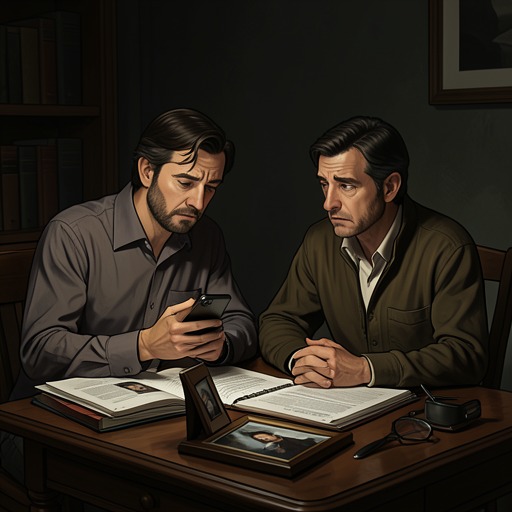
Thad Beaumont and Liz Beaumont
The Dark HalfThad Beaumont and Liz Beaumont are partners whose marriage must withstand the return of George Stark, Thad’s former pseudonym made flesh. Their relationship is not defined by unbroken agreement: Liz recognizes when Thad is concealing something, and his silence reopens old wounds. But when the danger becomes undeniable, she stands beside him, makes the case for his credibility, and names their family’s vulnerability plainly. The marriage’s decisive movement is from private mistrust toward a shared effort to confront a threat to them and their children.
Marriage and the return to Thad’s own name
After years of difficulty, Thad tells Alan Pangborn that life has recently improved for both him and Liz. Doctors had warned that Liz might not have another child and, when she became pregnant with William and Wendy, that she might not carry them to term. She did. Thad, meanwhile, has at last begun a third book under his own name after ten years. He identifies George Stark as the other name he wrote under and says that the separation from Stark began when Liz had reached her eighth month of pregnancy safely. Expecting to become a father again, Thad decided he should begin being himself again as well.
That account makes the return to his own name a marital as well as a professional change. It is linked to Liz’s pregnancy and to the prospect of raising children together, rather than presented simply as a decision about literary credit. Yet the name Thad had put aside does not remain safely in the past, and the family’s apparent good fortune becomes part of what is at stake when Stark resurfaces.
Trust, secrecy, and reconciliation
When Thad returns from an encounter with the sheriff, Liz sees that something is wrong. She tells him that keeping secrets is no good, and later states the deeper grievance directly: his silence feels like a lie. Her concern is not only that he has withheld information from Alan; she fears he may also keep it from her. She recognizes his uneasy expression and compares it to the look he had when claiming to have stopped drinking before he actually had. The comparison draws on their shared history and gives her suspicion a personal basis, rather than making it a response to the immediate mystery alone.
Liz’s fear and anger surface together. She asks whether Thad has found his way to understanding what is happening, then tells him that he looked guilty when the sheriff asked about the words written on Frederick Clawson’s wall. She soon regrets invoking his earlier dishonesty about drinking. Thad acknowledges that the comparison had once been true; he has not had a drink since completing the last Stark novel. The exchange shows both the force and the limits of their mistrust: their past supplies painful evidence, but Liz can recognize when anger has become unfair.
She then shifts from accusation to care. Liz reminds Thad that he has described a possible psychotic who believes he is George Stark and has killed two people they know. One of those victims, Frederick Clawson, had helped expose the Stark pseudonym. Despite the danger and the possibility that Thad himself is on the killer’s list, he has held something back. Liz asks him to identify the phrase that has unsettled him: “The sparrows are flying again.” When Thad says he cannot remember everything that happened, Liz does not force an answer. She suggests they go to bed; they laugh quietly together so as not to wake the babies, hold each other, and reach an understanding that, for the moment, the storm between them has passed. Their agreement to seek an appointment follows, though Thad says he will make it himself.
Liz’s account of George Stark
When Thad finally names George Stark to Alan, Liz supplies the explanation that connects his words to the evidence. She identifies Stark as Thad’s pseudonym and points out that the inscription on the photographed tombstone repeats the phrase Thad used to describe Stark to a wire-service reporter: “NOT A VERY NICE GUY.” Alan is startled and skeptical, but Liz insists that he listen before dismissing the account.
Her testimony is personal. Liz says that Stark was not merely unpleasant but horrible, and that each of his four books made her more nervous. When Thad decided to kill off the pseudonym, she went upstairs and cried with relief. She acknowledges that Frederick Clawson was a disgusting person, while also saying that his exposure of the pseudonym had done Thad and Liz a profound favor. She is sorry Clawson is dead, but she does not erase the relief she felt when Stark seemed to be gone. In defending Thad, she also reveals the emotional cost Stark had imposed on their marriage before his physical return.
Protecting the family
Liz’s appeal to Alan is grounded in immediate family stakes. She warns that if the sheriff does not try to believe Thad, the man—or whatever he is—may continue killing until he has finished his list of victims. She has personal reasons to prevent that outcome: she believes Thad, herself, and their babies may be on the list. Her appeal turns the couple’s account from an explanation of the past into a warning about what may happen next. Alan remains unsettled by the impossibility of the story, but agrees to let Thad continue.
The sparrows’ later appearances enlarge the danger beyond anything the couple can settle through conversation. At Gold’s Junkyard and Auto Supply, Thad and Rawlie DeLesseps find the stacked vehicles carpeted with silent sparrows. Later, Alan encounters the flock near the Williamses’ driveway: a bird lands on his shoulder, hops onto his hand, and then returns to the ground without attacking him. Alan judges that the birds seem to be holding back, as though the area were a staging ground. As Thad drives toward the house, a sparrow peers in from the car hood; he realizes the flock fills the road itself and that reaching the house means driving over it. These scenes place the family’s danger within a gathering presence that people cannot readily control.
At the climax, the sparrows become George Stark’s escort back to the land of the dead. Thad understands their arrival as Stark’s removal and retreats toward his children as the birds fill the air and settle on Stark. The ending carries the marriage’s central stakes into action: the threat that Liz had asked Alan to take seriously reaches the family’s immediate world, while Thad turns toward his children and the flock takes Stark away. Their relationship is therefore shaped not by certainty that they can command events, but by the trust and shared purpose that allow them to face them together.